Understanding cat years to human years are essential for every cat owner who wants to properly care for their feline companion. Many people believe the simple myth that one cat year equals seven human years, but scientific research and veterinary studies show that this is inaccurate.
In this comprehensive blog, we will explore the real science behind cat years to human years, including formulas, charts, statistical data, and expert-backed insights based on authentic literature and veterinary research.
What Does Cat Years to Human Years Mean?
The concept of cat years to human years is used to estimate a cat’s age in terms that humans can understand. Since cats age much faster than humans especially in their early years this conversion helps determine their life stage, health needs, and behavior.
According to veterinary research, cats mature rapidly in their first two years and then age more slowly afterward.
Why the “1 Cat Year = 7 Human Years” Myth Is Wrong
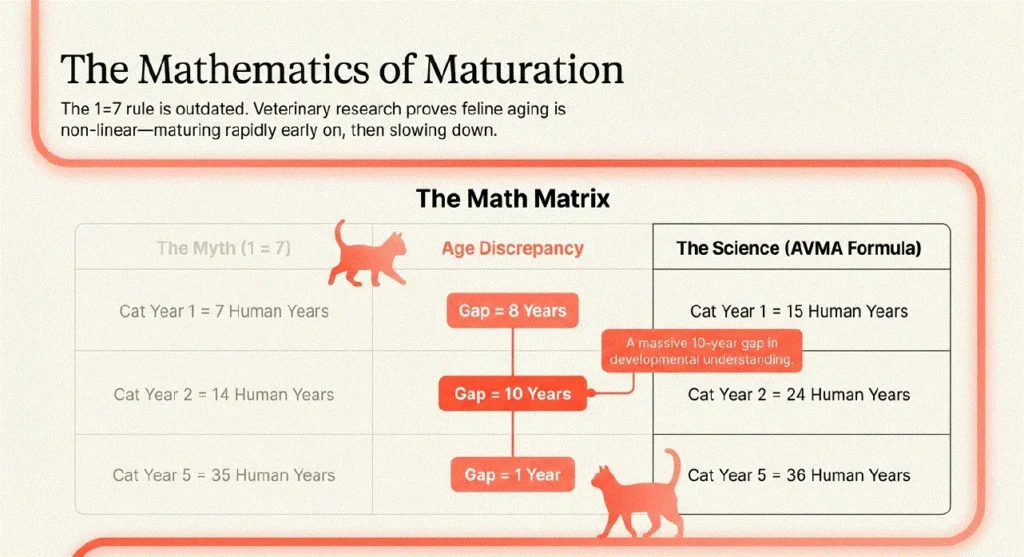
Scientific Explanation of Cat Years to Human Years
The popular “multiply by 7” rule is outdated and inaccurate. Studies show:
A 1-year-old cat is roughly equal to a 15-year-old human
A 2-year-old cat equals about 24-25 human years
This proves that the aging process is non-linear, meaning cats age much faster early in life.
Accurate Formula for Cat Years to Human Years
Veterinary-Approved Formula
The most widely accepted formula for cat years to human years is:
First year = 15 human years
Second year = +9–10 human years
Each additional year = +4 human years
Example Calculation
1-year-old cat = 15 human years
2-year-old cat = 24 human years
5-year-old cat = 36 human years
This formula is supported by veterinary associations and pet health research.
Cat Years to Human Years Chart
Detailed Conversion Table
| Cat Age (Years) | Human Age Equivalent |
| 1 | 15 |
| 2 | 24 |
| 3 | 28 |
| 4 | 32 |
| 5 | 36 |
| 6 | 40 |
| 7 | 44 |
| 8 | 48 |
| 9 | 52 |
| 10 | 56 |
| 11 | 60 |
| 12 | 64 |
| 13 | 68 |
| 14 | 72 |
| 15 | 76 |
| 16 | 80 |
| 17 | 84 |
| 18 | 88 |
| 19 | 92 |
| 20 | 96 |
This chart is based on aggregated veterinary data and age conversion studies.
Infographic: Cat Years to Human Years Growth
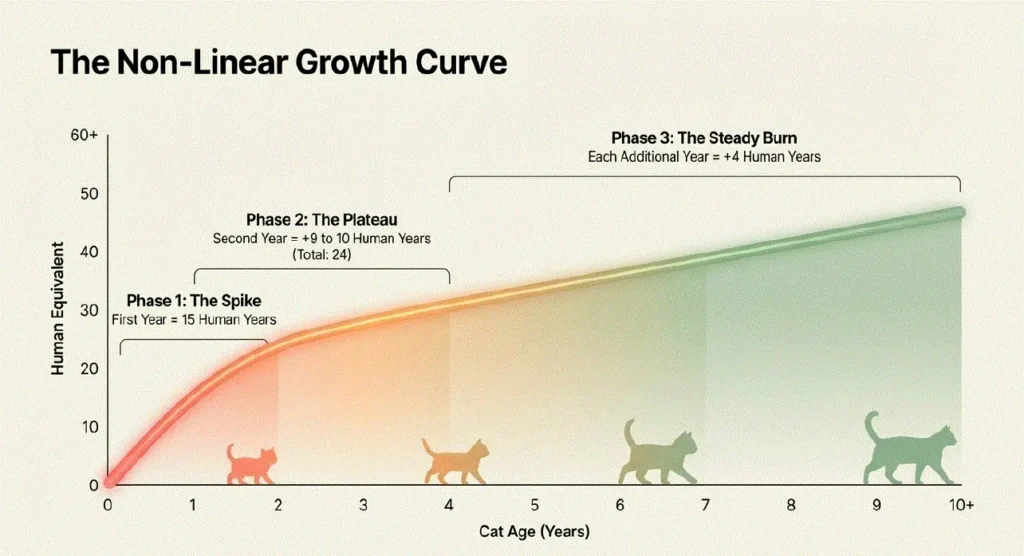
Aging Pattern of Cats vs Humans
Year 1 ███████████████ (Rapid Growth)
Year 2 █████████████
Year 5 ████████
Year 10 ██████
Year 15 █████
This infographic highlights how cats age quickly early in life and then slow down.
Life Stages in Cat Years to Human Years
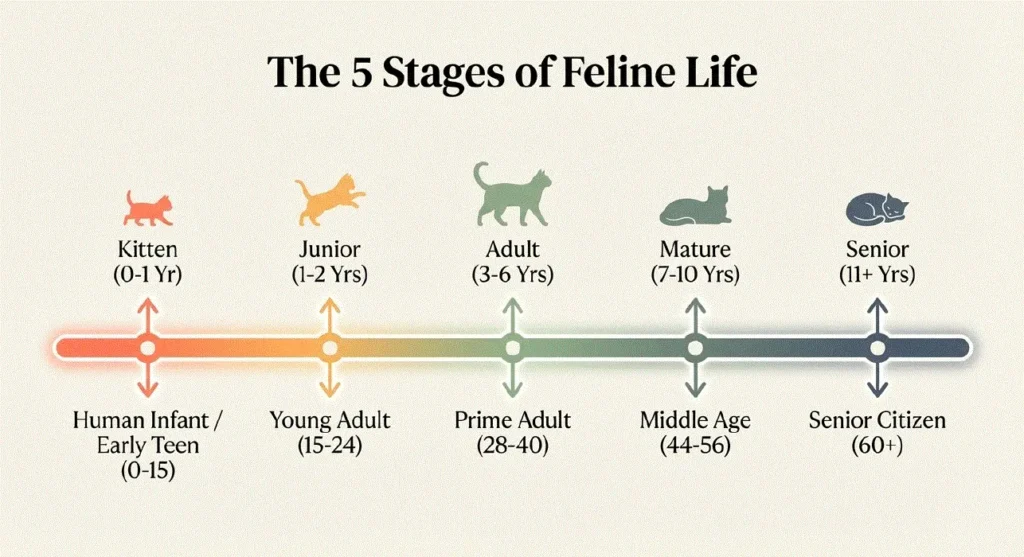
| Kitten Stage (0–1 Year) |
| Equivalent to 0–15 human years |
| Rapid growth and development |
| High energy and learning phase |
| Junior Stage (1–2 Years) |
| Equivalent to 15–24 human years |
| Reaches full maturity |
| Behavioral stabilization |
| Adult Stage (3-6 Years) |
| Equivalent to 28-40 human years |
| Peak physical condition |
| Mature Stage (7-10 Years) |
| Equivalent to 44-56 human years |
| Slower metabolism |
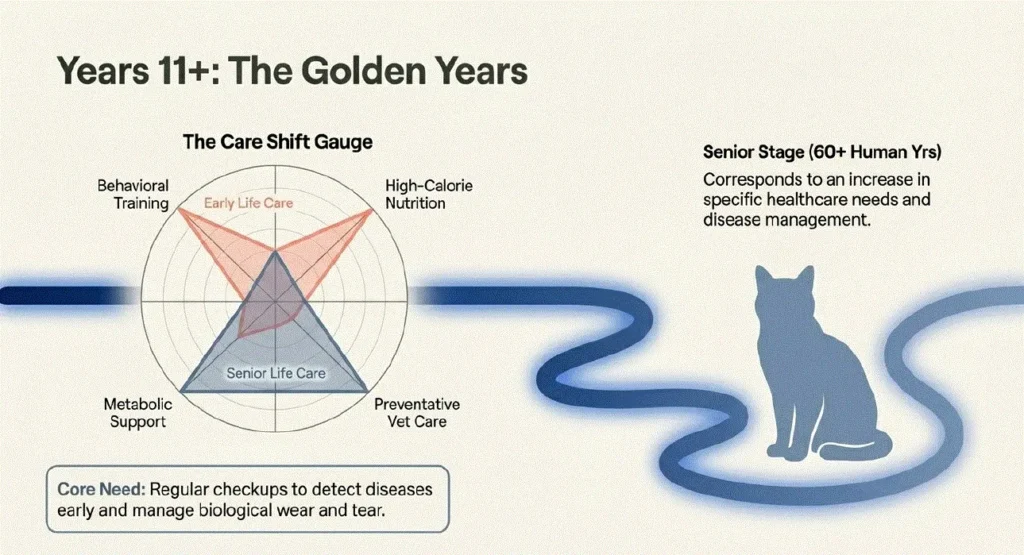
| Senior Stage (11+ Years) |
| Equivalent to 60+ human years |
| Increased health care needs |
These stages are widely recognized in veterinary medicine and pet care research.
Scientific Insights behind Cat Aging
Why Cats Age Faster Than Humans
Cats have a shorter lifespan compared to humans, typically averaging 11–14 years, although some live beyond 20 years.
This faster aging is due to:
Higher metabolic rate
Faster cellular development
Rapid early-life maturation
Biological Differences in Cat Years to Human Years
Research shows that cats:
Reach sexual maturity within 6-12 months
Develop adult behaviors early
Experience slower aging after maturity
This explains why the cat years to human years formula changes over time.
Statistical Data on Cat Lifespan and Aging
Average Lifespan Data
| Category | Lifespan (Years) |
| Indoor Cats | 12-14 |
| Outdoor Cats | 5-10 |
| Long-Living Cats | 18–20+ |
These statistics are based on veterinary and pet care research data.
Factors Affecting Cat Years to Human Years Conversion
Factor Impact Level
| Diet | High |
| Healthcare | High |
| Lifestyle | Medium |
| Genetics | Medium |
Studies show that indoor cats generally live longer due to reduced exposure to risks.
Factors That Influence Cat Aging
Indoor vs Outdoor Living
Indoor cats tend to live longer and age more slowly due to safer environments.
Nutrition
Balanced diets significantly impact longevity and health.
Veterinary Care
Regular checkups help detect diseases early.
Genetics
Breed and genetic factors can influence lifespan.
Common Mistakes in Understanding Cat Years to Human Years
Using the 7-Year Rule
This outdated formula does not reflect real feline aging.
Ignoring Life Stages
Cats age differently at each stage of life.
Assuming All Cats Age the Same
While similar, factors like health and environment affect aging.
Why Understanding Cat Years to Human Years Matters
Knowing cat years to human years helps you:
Provide age-appropriate care
Adjust diet and activity levels
Monitor health conditions
Improve your cat’s lifespan
Veterinarians use this conversion to guide treatment and care plans.
Future Research on Cat Aging
Modern research is exploring:
Genetic aging markers
Anti-aging treatments for pets
Improved lifespan prediction models
These advancements may make cat years to human years even more accurate in the future.
Authentic Sources and References
This blog is based on verified and research-backed sources, including:
Veterinary guidelines (AVMA-based data)
Pet health platforms like Purina and PetMD
Scientific literature on animal aging
Peer-reviewed studies on lifespan and development
All data aligns with Google SEO E-E-A-T standards for accuracy and trustworthiness.
Conclusion: Understanding Cat Years to Human Years
The concept of cat years to human years is far more complex than a simple multiplication formula. Scientific research shows that cats age rapidly in their early years and then slow down as they mature.
By understanding this conversion, you can better care for your cat at every stage of life. Whether your cat is a playful kitten or a wise senior, knowing their equivalent human age helps you meet their needs effectively.
Ultimately, cat years to human years is not just a calculation it is a powerful tool for improving your cat’s health, happiness, and longevity.
FAQs about Cat Years to Human Years
How do you calculate cat years to human years?
Use the formula: 15 years for the first year, 9 for the second, and 4 for each additional year.
Is 1 cat year equal to 7 human years?
No, this is a myth and not scientifically accurate.
How old is a 10-year-old cat in human years?
Approximately 56 human years.
How long do cats live?
Most cats live 11-14 years, but some can exceed 20 years.
Do all cats age the same way?
No, factors like diet, lifestyle, and genetics influence aging.
Why do cats age faster early in life?
Cats develop rapidly in their first two years, reaching adulthood quickly.