Introduction
The question “how many cats are in the world” is one of the most searched queries among pet lovers and researchers alike. Cats (Felis catus) are among the most widespread animals on Earth, living in homes, streets, farms, and even wild ecosystems.
According to multiple literature reviews and global datasets, the total number of cats worldwide is estimated between 600 million and over 1 billion.
However, determining the exact number is challenging due to:
Unregistered pet ownership
Large stray and feral populations
Lack of global census systems
This research-based blog explores how many cats are in the world, including statistical data, distribution, population categories, and scientific insights.
How Many Cats Are in the World: Global Estimates
Latest Global Cat Population Data
The most widely accepted answer to how many cats are in the world falls within this range:
| Category | Estimated Population |
| Total cats worldwide | 600 million – 1 billion |
| Pet (domestic) cats | 350 – 373 million |
| Stray/Feral cats | 480 million |
| Wild cats (lions, tigers, etc.) | 100 million |
Infographic Summary (Text-Based)
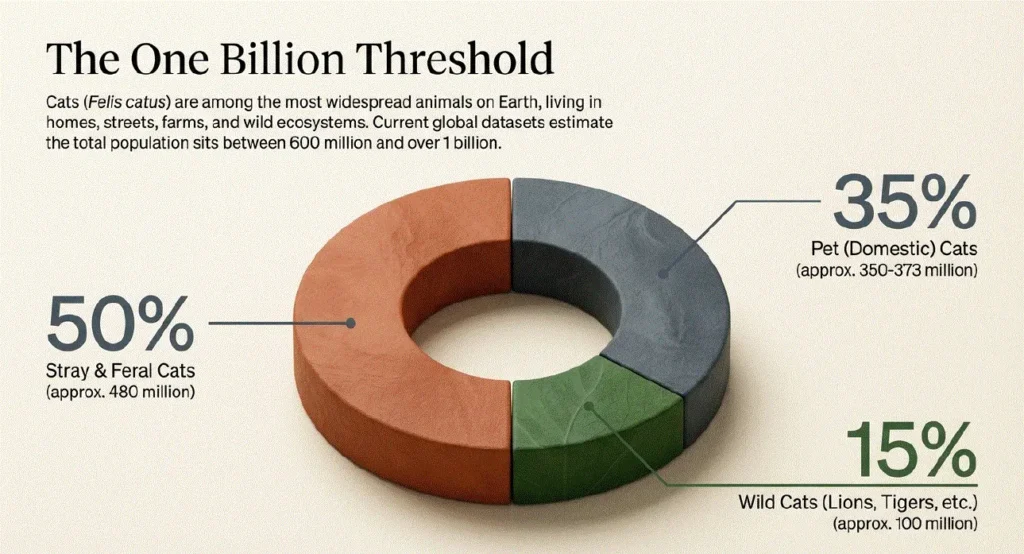
35% Pet Cats
50% Stray/Feral Cats
15% Wild Cats
These figures are based on compiled data from global animal welfare organizations and ecological studies.
Why It Is Difficult to Measure How Many Cats Are in the World
Key Challenges in Global Cat Population Estimation
Understanding how many cats are in the world is complex due to several scientific limitations:
Lack of Global Registration Systems
Unlike humans, cats are not officially counted worldwide. Many countries do not track pet ownership accurately.
Large Feral Population
Feral cats live independently and reproduce rapidly, making them difficult to monitor. Estimates suggest hundreds of millions of stray cats exist globally.
Semi-Owned Cats
Some cats are fed by humans but not officially owned, creating classification challenges.
Rapid Reproduction Rate
Scientific literature shows a female cat can produce up to 40 kittens in 5 years, leading to exponential growth.
How Many Cats Are in the World by Category
Pet Cats (Domestic Cats)
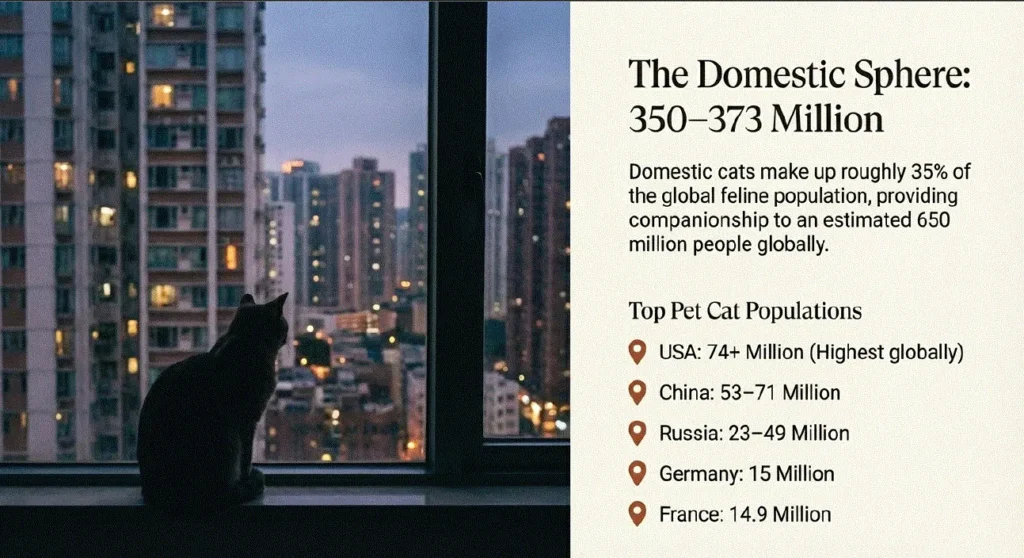
Domestic cats make up a large portion of the global feline population.
Estimated: 350–373 million pet cats worldwide
Around 650 million people own cats globally
Top Countries with Most Pet Cats
| Country | Estimated Cat Population |
| United States | 74+ million |
| China | 53–71 million |
| Russia | 23–49 million |
| Germany | 15 million |
| France | 14.9 million |
Stray and Feral Cats
Stray cats are the largest group, which significantly impacts the answer to how many cats are in the world.
Estimated: 200 million to over 600 million stray cats globally
Many are born in the wild and never interact with humans
Key Characteristics
Live in colonies
High reproduction rate
Depend on urban waste or human feeding
Wild Cats
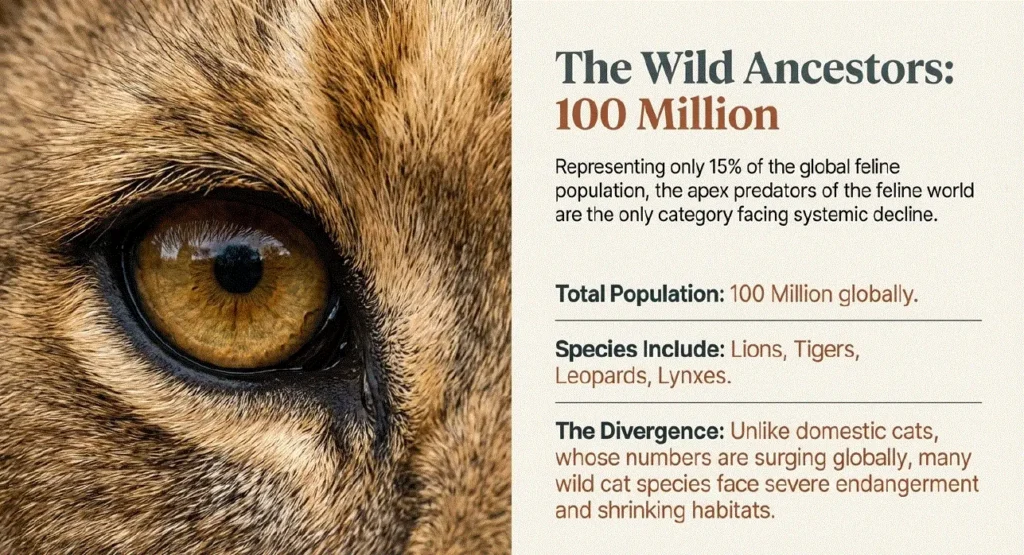
Wild cats include species such as:
Lions
Tigers
Leopards
Lynxes
Estimated population: 100 million globally
However, many wild cat species are endangered, unlike domestic cats whose numbers are increasing.
How Many Cats Are in the World Compared to Other Animals
Cats vs Other Popular Pets
| Animal | Estimated Population |
| Cats | 600 million – 1 billion |
| Dogs | 900 million |
| Birds (pets) | 300 million |
| Fish (pets) | Tens of millions |
Cats are among the top 2 most common pets globally, competing closely with dogs.
Global Distribution: Where Do Most Cats Live?
Urban vs Rural Distribution
Understanding how many cats are in the world also requires analyzing where they live.
Urban Areas
High concentration of pet and stray cats
Easy access to food and shelter
Rural Areas
More feral cats
Often used for pest control
Continental Presence
Growth Trends: Is the Cat Population Increasing?
Recent Trends in Global Cat Population
The number of cats is steadily increasing worldwide due to:
Urbanization
Cats adapt well to apartment living.
Rising Pet Ownership
Especially in developing countries.
Lack of Sterilization
Uncontrolled breeding contributes heavily to population growth.
Pandemic Impact
Pet adoption increased significantly during COVID-19.
Scientific Insights: Reproduction and Population Growth
Why Cat Numbers Grow So Fast
Cats reproduce faster than many animals:
| Sexual maturity: | 4-6 months |
| Litters per year: | 2-3 |
| Kittens per litter: | 1-10 |
This exponential growth explains why answering how many cats are in the world always results in estimates rather than exact numbers.
Impact of the Global Cat Population
Positive Impacts
Companionship for humans
Mental health benefits
Pest control in agriculture
Negative Impacts
Wildlife predation
Overpopulation of strays
Spread of diseases
Future Projections: How Many Cats Will Be in the World?
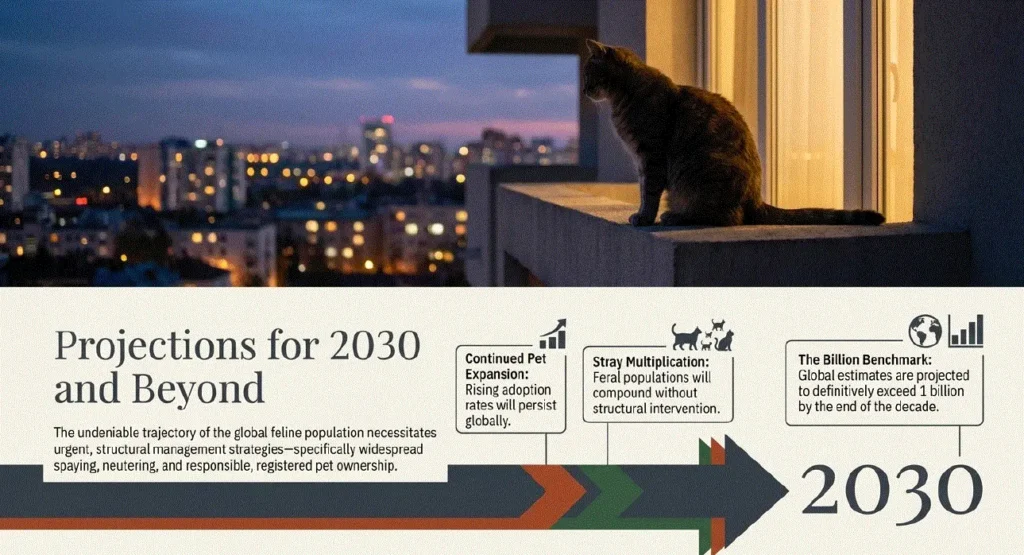
Expected Growth by 2030
Experts predict:
Continued increase in pet ownership
Rising stray populations without intervention
Potential to exceed 1 billion cats globally
Authentic Sources and Research References
The data in this blog is compiled from:
Environmental Literacy Council
MDPI Scientific Literature Review
World Animal Foundation
Hepper Pet Resources
These sources rely on:
Ecological studies
Population modeling
Veterinary and animal welfare research
Conclusion
To summarize, the answer to how many cats are in the world is not a fixed number but an informed estimate:
Between 600 million and over 1 billion cats globally
This includes:
Domestic pets
Stray and feral populations
Wild feline species
The growing number of cats reflects their adaptability, popularity, and high reproduction rate. However, it also highlights the need for better population management strategies, such as spaying, neutering, and responsible pet ownership.
FAQs: How Many Cats Are in the World
What is the current global population of cats?
There are approximately 600 million to 1 billion cats worldwide, including pets, strays, and wild cats.
How many pet cats are there globally?
There are around 350-373 million pet cats worldwide.
Are there more stray cats than pet cats?
Yes, in many estimates, stray and feral cats outnumber pet cats.
Which country has the most cats?
The United States has the highest number of pet cats, followed by China and Russia.
Why is it hard to count cats globally?
Because of:
Unregistered ownership
Large feral populations
Lack of global tracking systems