Complete Cat Owner Guide
Quick Answer
An automatic litter box can make daily cat care easier, but it does not replace routine cleaning, observation, or veterinary care. If your cat suddenly stops producing urine, repeatedly strains in the box, cries while trying to urinate, or becomes weak or distressed, seek veterinary care immediately. A complete urethral obstruction is a life-threatening emergency, especially in male cats.
If your cat is otherwise healthy, an automated box may be a convenient option. The key is choosing a safe design, introducing it gradually, keeping it maintained, and continuing to monitor your cat’s urine and stool habits.
Editorial note: This article is informational and has been reviewed against current guidance from recognized veterinary authorities, including Cornell Feline Health Center, Merck Veterinary Manual, and VCA Animal Hospitals. It does not diagnose or treat an individual cat. A veterinarian should evaluate concerning changes in urination, defecation, appetite, behavior, or overall health.
What Is an Automatic Litter Box?
An automatic litter box is a cat toilet that uses a mechanical system to remove urine clumps or feces with less manual scooping.
Different products use different designs. Some rotate the litter chamber, some rake waste into a separate compartment, and others use sifting or conveyor-style systems.
The main purpose is convenience.
Instead of manually removing every clump, the machine performs part of the cleaning process automatically. This can be useful for busy cat owners or households with several cats.
However, the word “automatic” can be misleading.
An automatic box is not maintenance-free.
You still need to:
- Empty the waste container.
- Add or replace litter.
- Clean the box.
- Clean mechanical components.
- Check sensors and moving parts.
- Replace filters when required.
- Monitor your cat’s litter-box habits.
The machine also cannot tell you whether your cat is sick.
That matters because changes in litter-box behavior can sometimes be the first noticeable sign of a medical problem. Cornell notes that urinary, digestive, mobility, and other health conditions can contribute to inappropriate elimination.
Is an Automatic Litter Box Safe for Cats?
For many cats, a properly designed and correctly maintained automatic system can be a reasonable option.
But safety depends on more than the machine itself.
Before using one, consider:
- The cat’s size and weight.
- The entrance height.
- Interior space.
- The stability of the unit.
- Noise level.
- Moving mechanisms.
- Sensor design.
- Electrical safety.
- Required litter type.
- Cleaning requirements.
- Your cat’s temperament.
- Your cat’s age and mobility.
A large, confident cat may adapt quickly to a mechanical system.
A nervous kitten or older cat with arthritis may need a different setup.
Cats also have strong preferences about their toilets. Cornell’s litter-box guidance notes that many cats prefer quiet, accessible boxes and that older or mobility-limited cats may need low-sided boxes.
If your cat becomes frightened by the motor, vibration, movement, or sound, forcing the transition is not a good strategy.
Keep a familiar litter box available.
When a Litter-Box Problem Is an Emergency
The most important emergency issue related to litter-box behavior is urinary obstruction.
A cat that repeatedly enters the box, strains, cries, and produces little or no urine may have a serious urinary problem.
A cat that cannot urinate normally may have a life-threatening urinary obstruction and needs immediate veterinary attention.
Male cats are particularly vulnerable because their urethra is narrower and longer, making blockage more likely.
Seek emergency veterinary care if your cat:
- Repeatedly strains to urinate.
- Produces no urine.
- Produces only a few drops despite repeated attempts.
- Cries or vocalizes while trying to urinate.
- Frequently enters and leaves the litter box.
- Shows obvious pain or distress.
- Becomes weak or severely lethargic.
- Vomits while showing urinary signs.
- Collapses.
- Has a history of urinary blockage and develops similar symptoms.
Do not wait for an automatic cleaning cycle to tell you what happened.
Do not assume the cat is constipated.
Do not try to unblock the urinary tract at home.
Contact an emergency veterinary service.
Merck Veterinary Manual identifies urethral obstruction as a urinary emergency and explains that obstructed animals may make frequent, nonproductive attempts to urinate.
Why an Automatic Box Can Sometimes Hide a Problem
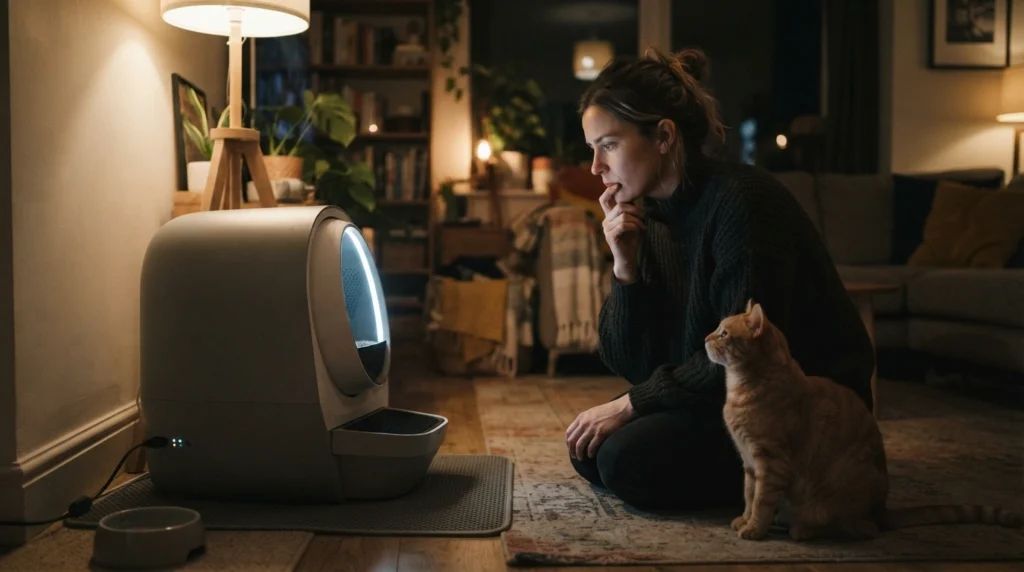
Automation is convenient, but it can also remove useful information.
A traditional litter box allows you to notice:
- The approximate amount of urine.
- Urine clump size.
- Stool consistency.
- Blood or unusual discoloration.
- Changes in frequency.
- Changes in the amount of waste.
An automated system may immediately move waste into a covered compartment.
That means owners need to be more deliberate about monitoring.
For example, a machine may make the litter area look perfectly clean while the cat is actually making repeated attempts to urinate.
Cornell notes that frequent attempts, painful urination, blood in the urine, and inappropriate urination can all be signs of lower urinary tract disease.
A “clean” automated box should therefore never be interpreted as proof that your cat is healthy.
Warning Signs Every Cat Owner Should Know
Not every litter-box change is an emergency, but sudden or persistent changes deserve attention.
Watch for:
- Urinating outside the box.
- Defecating outside the box.
- Frequent litter-box visits.
- Straining.
- Crying during elimination.
- Blood in urine.
- Excessive genital licking.
- Very small urine clumps.
- Constipation.
- Diarrhea.
- Sudden changes in urine volume.
- Sudden changes in stool.
- Avoidance of the litter box.
- Hiding or unusual behavior.
- Loss of appetite.
- Reduced activity.
VCA notes that cats with urinary tract problems may urinate frequently, pass small amounts, strain, cry, show blood in urine, or urinate outside the litter box.
Cornell also emphasizes that medical problems can cause house-soiling and that cats may not always appear obviously sick.
Emergency Signs vs. Problems Needing Veterinary Assessment
| Litter-box sign | What it may indicate | Recommended action |
|---|---|---|
| No urine despite repeated straining | Possible urinary obstruction | Emergency veterinary care |
| Frequent attempts with tiny amounts | Lower urinary tract problem | Prompt veterinary assessment |
| Crying while urinating | Pain or urinary disease | Contact veterinarian promptly |
| Blood in urine | Urinary tract problem | Veterinary evaluation |
| Sudden accidents outside the box | Medical or behavioral issue | Veterinary assessment if persistent or sudden |
| Hard, dry stool | Constipation or another issue | Veterinary advice if persistent |
| Diarrhea | Gastrointestinal problem | Veterinary advice if ongoing or severe |
| Refusing a new automated box | Fear or litter-box aversion | Restore familiar box and monitor |
| Dirty or malfunctioning machine | Environmental issue | Clean or service the unit |
This table is not a diagnosis. Only a veterinarian can determine the cause of an individual cat’s symptoms.
How an Automatic Litter Box Works
Automatic litter boxes vary significantly.
Rotating systems
Some units rotate the litter chamber after the cat leaves.
During the cycle, waste is separated from reusable litter and deposited into a waste compartment.
Raking systems
Other products use a mechanical rake that moves across the litter surface and pushes waste into a collection area.
Sifting systems
Sifting designs separate waste from clean litter through a screen or specialized tray.
Conveyor systems
Some systems move waste through a conveyor mechanism into a separate receptacle.
The cleaning method is less important than whether the cat comfortably uses the box and whether the owner can safely maintain it.
Before purchasing any system, read the manufacturer’s specifications carefully.
Benefits of an Automatic Litter Box
1. Less daily scooping
This is the main advantage.
For owners who find daily litter maintenance difficult, automation can make routine care more manageable.
2. Waste can be removed more frequently
If the machine operates correctly, feces and urine clumps can be removed without waiting for the owner to scoop.
Cats often prefer clean litter areas. Cornell recommends keeping litter boxes clean and notes that many cats dislike foul odors.
3. Useful for some busy households
An automated system can reduce the amount of time required for routine litter maintenance.
However, convenience should not become an excuse to stop inspecting the litter area.
4. Potentially useful in multi-cat homes
Multiple cats can create a large amount of waste.
An automated system may reduce manual labor, although one machine should not automatically be considered sufficient for a multi-cat household.
Cornell recommends a general starting point of one litter box per cat plus one additional box.
5. May help owners maintain consistency
Regular waste removal can make it easier to maintain a predictable litter routine.
That can be useful for cats that are sensitive to dirty or strongly scented boxes.
Limitations of Automatic Litter Boxes
They are not maintenance-free
You still need to:
- Empty waste containers.
- Refill litter.
- Wash components.
- Inspect the mechanism.
- Check sensors.
- Replace filters where applicable.
- Deal with stuck waste.
- Monitor odors.
They can make health monitoring harder
This is one of the most important disadvantages.
If the machine immediately removes waste, you may not notice changes unless you deliberately check the system.
Some cats dislike mechanical movement
A cat may become frightened by:
- Motor noise.
- Vibration.
- Moving litter.
- Sudden cleaning cycles.
- Unfamiliar smells.
- A covered interior.
- A cramped entrance.
Mechanical failures can occur
A jammed mechanism or sensor problem can interfere with normal operation.
Owners should therefore inspect the unit rather than assuming that it is functioning correctly.
How to Choose the Right Automatic Litter Box
There is no single best model for every cat.
Consider the entrance
Older cats, kittens, and cats with mobility problems may need a lower entrance.
Consider interior space
Large cats need enough room to turn around and adopt a normal elimination posture.
A box that is technically large enough to enter may still be uncomfortable.
Consider noise
A nervous cat may tolerate a quiet mechanism better than a loud one.
Check safety features
Look for information about:
- Motion detection.
- Weight sensors.
- Cleaning-cycle timing.
- Motor safety.
- Jam detection.
- Emergency shutoff features.
Do not rely only on marketing language. Read the manufacturer’s technical documentation.
Check litter compatibility
Some systems work only with certain types of litter.
Before buying, make sure the required litter is appropriate for your cat and acceptable to the manufacturer.
Consider maintenance
A complicated machine may be inconvenient if it requires extensive disassembly.
Choose a design you can realistically clean.
Introducing an Automatic Litter Box
A gradual transition is usually easier than making an abrupt change.
Step 1: Keep the old box
Do not immediately remove the familiar litter box.
Place the new unit nearby.
Step 2: Use familiar litter
If compatible with the manufacturer’s instructions, start with the litter your cat already knows.
Step 3: Let your cat investigate
Allow the cat to approach the new box voluntarily.
Do not force the cat inside.
Step 4: Delay the automated cycle
If the product permits it, initially keep the cleaning function off or delayed so your cat can become comfortable with the machine.
Step 5: Observe behavior
Look for hesitation, avoidance, or fear.
If your cat stops using the box, restore the familiar setup.
The goal is not to make your cat accept a gadget.
The goal is to provide a safe, comfortable toilet area.
Where Should You Put an Automatic Litter Box?
Location matters.
Cats generally benefit from a quiet, private, accessible place.
Cornell recommends litter boxes in quiet locations that are separate from feeding areas and accessible around the clock.
Avoid placing the box:
- Beside loud washing machines.
- In high-traffic areas.
- Where dogs can disturb the cat.
- Behind closed doors.
- At the top or bottom of difficult stairs for mobility-limited cats.
- Next to food and water.
- In a location where another cat can block access.
In a multi-cat household, consider distributing boxes across different areas.
Cleaning and Maintenance
An automatic box still needs regular cleaning.
A practical routine includes:
- Check the waste compartment.
- Empty it before it becomes overloaded.
- Check litter depth.
- Inspect the entrance and interior.
- Look for stuck clumps.
- Clean removable components as directed.
- Check sensors.
- Inspect moving mechanisms.
- Replace filters when required.
- Check the power cord and electrical components.
- Follow the manufacturer’s deep-cleaning schedule.
Never ignore unusual sounds, repeated jams, overheating, or unexpected movement.
If the machine appears unsafe, stop using it until the issue has been addressed.
Automatic Litter Boxes and Urinary Health
An automatic box does not prevent urinary disease.
Feline lower urinary tract disease includes several conditions involving the bladder and urethra. Common signs include painful or difficult urination, frequent urination, blood in urine, inappropriate urination, and excessive genital licking.
Possible causes include:
- Feline idiopathic cystitis.
- Urinary stones.
- Urethral plugs.
- Urethral obstruction.
- Other urinary disorders.
A veterinarian must determine the actual cause.
Why clean litter matters
A clean, accessible litter box may encourage normal elimination and reduce litter-box aversion.
But it should never be considered a treatment for urinary disease.
If your cat is repeatedly straining or producing little or no urine, seek veterinary care rather than changing litter or waiting for the machine to complete another cycle.
Automatic Litter Boxes and Constipation
Owners sometimes confuse urinary straining with constipation.
This can be dangerous.
A cat sitting in the litter box and repeatedly pushing may be trying to urinate, defecate, or both.
Merck Veterinary Manual notes that owners can mistake urinary obstruction for constipation.
Possible signs of constipation can include:
- Small, hard stools.
- Infrequent bowel movements.
- Repeated straining.
- Discomfort during defecation.
- Reduced appetite.
- Changes in normal litter-box behavior.
Persistent constipation should be discussed with a veterinarian.
If you are unsure whether your cat is trying to urinate or defecate, do not assume.
What Does a Veterinary Workup Involve?
When a cat develops a significant change in litter-box behavior, the veterinarian will usually begin with a detailed history and physical examination.
You may be asked:
- When did the problem begin?
- How often is your cat entering the box?
- Is urine actually being produced?
- How much urine is being produced?
- Is stool being passed?
- What does the stool look like?
- Has appetite changed?
- Is water consumption different?
- Has vomiting occurred?
- Has the home environment changed?
- Has a new litter box been introduced?
- How many cats live in the home?
- What litter is being used?
Depending on the signs, testing may include:
- Physical examination.
- Urinalysis.
- Blood tests.
- Urine culture.
- X-rays.
- Ultrasound.
- Additional imaging or specialized testing.
Cornell states that physical examination and urinalysis are commonly part of the initial evaluation for feline lower urinary tract signs, with blood work, radiographs, ultrasound, and urine culture used when indicated.
Merck similarly describes physical examination, radiography, blood work, and urinalysis as important components of evaluating urinary obstruction.
How Urinary Obstruction Is Treated
Treatment depends on the cause and the cat’s condition.
For a confirmed urinary obstruction, veterinary treatment focuses on stabilizing the patient and restoring urine flow.
Depending on the case, treatment may include:
- Intravenous fluids.
- Pain management.
- Sedation or anesthesia.
- Urinary catheterization.
- Correction of electrolyte abnormalities.
- Monitoring kidney function.
- Hospitalization.
- Treatment of the underlying cause.
Merck describes stabilization, decompression when needed, and relief of the obstruction as key treatment priorities.
This is why a suspected obstruction should never be managed by changing the litter box at home.
Preventing Litter-Box Problems
Good litter-box management can support normal behavior.
Provide enough boxes
A useful starting point is one box per cat plus one extra.
Keep boxes accessible
Cats should be able to reach them easily at all times.
Keep litter clean
Automation can help, but manual inspection remains important.
Avoid sudden changes
Changing litter, location, box style, and household routine at the same time can create unnecessary stress.
Monitor water access
Fresh water should always be available.
Watch for urinary changes
Know what normal urination looks like for your cat.
Reduce environmental stress
Cornell identifies environmental modification and stress reduction as useful components in managing feline lower urinary tract problems, particularly idiopathic cystitis.
Consider age and mobility
Older cats may need a low-entry option.
When to Seek Emergency Care vs. Scheduled Care
Emergency care
Seek immediate veterinary attention for:
- No urine despite repeated attempts.
- Severe straining.
- Severe pain.
- Crying during repeated attempts to urinate.
- Increasing distress.
- Weakness or collapse.
- Repeated vomiting alongside urinary signs.
- Suspected urinary obstruction.
Prompt veterinary appointment
Arrange veterinary assessment for:
- Persistent litter-box avoidance.
- Blood in urine.
- Repeated small urine clumps.
- Increased urination.
- New constipation.
- Persistent diarrhea.
- Recurrent accidents.
- Increased thirst with increased urination.
- Changes in appetite or weight.
Environmental troubleshooting
If your cat is otherwise healthy and simply dislikes a new box, you can first restore the familiar litter box and consider whether the problem is related to:
- Location.
- Litter texture.
- Litter odor.
- Box size.
- Noise.
- Cleaning cycles.
- Accessibility.
But sudden changes should not automatically be labeled behavioral. Cornell recommends veterinary evaluation when cats develop persistent house-soiling problems because medical disease can be involved.
Is an Automatic Litter Box Worth It?
For the right cat and household, it can be.
It may be particularly useful if you:
- Want to reduce daily scooping.
- Have a busy schedule.
- Can perform regular maintenance.
- Have a cat that accepts mechanical equipment.
- Want more consistent waste removal.
It may be less suitable if your cat:
- Is highly sensitive to noise.
- Is frightened by movement.
- Has mobility problems.
- Refuses enclosed or unusual litter boxes.
- Needs close monitoring of urine output.
- Has a history of urinary disease requiring detailed observation.
Convenience should never outweigh your cat’s comfort or health.
FAQs About Automatic Litter Boxes
Is an automatic litter box safe for cats?
A properly designed and maintained automatic litter box can be safe for many cats. Safety depends on the specific design, appropriate sizing, correct use, maintenance, and your cat’s individual response to the device.
Can an automatic litter box replace a regular litter box?
Not necessarily. Some cats prefer traditional boxes. Keeping a conventional box available can also make transitions easier and provide an alternative if your cat dislikes the automated system.
Do automatic litter boxes really clean themselves?
They automate part of the waste-removal process, but they do not eliminate maintenance. Owners still need to empty waste compartments, replenish litter, clean surfaces, inspect components, and replace filters when required.
Can an automatic litter box cause a cat to stop using the litter box?
A cat may avoid an automated box if it dislikes its noise, movement, size, location, litter, or cleaning cycle. However, sudden avoidance can also be caused by medical problems, so persistent or abrupt changes deserve veterinary attention.
How many litter boxes should I have for multiple cats?
A commonly recommended starting point is one litter box per cat plus one additional box. Individual households may need more depending on layout, cat relationships, age, mobility, and health.
Why is my cat going to the litter box repeatedly but producing little urine?
Repeated attempts with only small amounts of urine can indicate lower urinary tract disease and may be an early sign of obstruction. If your cat repeatedly strains and produces no urine, seek emergency veterinary care immediately.
Can an automatic litter box prevent urinary problems?
No. Keeping a clean and accessible toilet area may support good litter-box habits, but an automated box cannot prevent all urinary diseases. Cats with urinary symptoms need veterinary evaluation.
Should older cats use an automatic litter box?
It depends on their mobility and preferences. Older cats with arthritis or other mobility problems may need a low-entry, easily accessible box.
How often should an automatic litter box be cleaned?
Follow the manufacturer’s instructions and inspect the unit regularly. Empty the waste compartment as needed, clean removable parts, check for stuck litter, and maintain filters or other components according to the product’s requirements.
Internal-Link Opportunities
For a cat-health website, consider these internal links:
- “cat urinary blockage symptoms” → detailed emergency urinary obstruction guide.
- “cat litter box problems” → comprehensive house-soiling guide.
- “signs of constipation in cats” → feline constipation resource.
- “how to choose the right litter box” → litter-box selection guide.
- “feline lower urinary tract disease” → detailed urinary-health article.