Complete Cat Owner Guide
Quick Answer: A self cleaning litter box can reduce daily scooping and help some cat owners maintain a cleaner toilet area, but it does not replace routine cleaning or veterinary care. If your cat suddenly stops using the box, repeatedly strains without producing urine, cries while trying to urinate, or shows severe distress, treat the situation as a potential medical emergency and contact a veterinarian immediately. A blocked urethra is a life-threatening emergency, particularly in male cats.
Editorial note: This article is informational and has been reviewed against current veterinary guidance from recognized sources including Cornell Feline Health Center, Merck Veterinary Manual, and VCA Animal Hospitals. It does not diagnose or treat an individual cat. A veterinarian should evaluate concerning changes in urination, defecation, appetite, behavior, or litter-box habits.
What Is a Self Cleaning Litter Box?
A self cleaning litter box is an automated litter system designed to remove urine clumps or feces from the main litter area with limited manual scooping.
Depending on the design, the device may use a rotating mechanism, rake, conveyor, sifting system, or other automated process. Waste is moved into a separate receptacle, allowing the cat to have a cleaner toilet area between routine maintenance sessions.
The main appeal is convenience.
Traditional litter boxes usually require frequent scooping. An automated model can reduce that daily workload and may make it easier for busy owners to keep waste from accumulating.
However, “self-cleaning” does not mean “maintenance-free.”
The litter still needs to be replenished, the waste container emptied, components cleaned, and the manufacturer’s maintenance instructions followed.
More importantly, owners still need to observe their cats.
A machine can remove waste, but it cannot determine whether a cat is urinating normally, passing normal stools, straining, visiting the box unusually often, or avoiding the box because of pain.
That distinction is especially important because changes in litter-box behavior can sometimes be the first visible sign of illness. Cornell notes that urinary disease, digestive problems, mobility issues, and other medical conditions can contribute to inappropriate elimination.
Is a Self Cleaning Litter Box Safe for Cats?
In general, an appropriately designed and properly maintained automatic box can be a useful option for many cats.
But safety depends on the specific product, the cat, and how the device is operated.
Before using an automated system, consider:
- Whether the opening is large enough for your cat.
- Whether the entrance is easy to access.
- Whether the cat can comfortably turn around.
- Whether the device has appropriate safety sensors.
- Whether moving parts are enclosed or otherwise designed to reduce injury risk.
- Whether the waste mechanism can operate without trapping or frightening the cat.
- Whether the litter type is compatible with the device.
- Whether the unit is stable and difficult to tip.
- Whether electrical components are protected from moisture.
- Whether the manufacturer’s age, weight, and usage recommendations are appropriate.
Do not assume that an expensive machine is automatically safer than a simpler box.
The individual cat matters.
Some cats adapt quickly to an automated litter system. Others may be frightened by the motor, movement, vibration, noise, or unfamiliar shape.
If a cat refuses to enter, do not force it.
Maintaining access to a familiar litter box can prevent unnecessary stress and reduce the risk of inappropriate elimination.
When a Litter-Box Problem Is an Emergency
The most important emergency concern associated with litter-box behavior is urinary obstruction.
A cat that repeatedly enters the litter box, strains, cries, and produces little or no urine may have a serious urinary problem. Cornell describes urethral obstruction as an absolute emergency requiring immediate veterinary attention.
Merck Veterinary Manual also identifies urethral obstruction as a urinary emergency. Male cats are particularly predisposed because of the anatomy of their urinary tract.
Seek emergency veterinary care if your cat:
- Repeatedly strains to urinate.
- Produces no urine.
- Produces only tiny amounts despite repeated attempts.
- Cries or appears extremely painful while urinating.
- Becomes increasingly distressed.
- Becomes weak, depressed, or collapses.
- Has severe abdominal discomfort.
- Repeatedly enters and exits the litter box without normal urine production.
- Has a known history of urinary obstruction and develops similar signs.
A suspected urinary blockage is not a situation to monitor at home or troubleshoot with a different litter box.
An automated litter system can actually make observation harder if it immediately removes urine clumps. For cats with known urinary disease, owners should ask their veterinarian how best to monitor urine output.
Warning Signs That Should Not Be Ignored
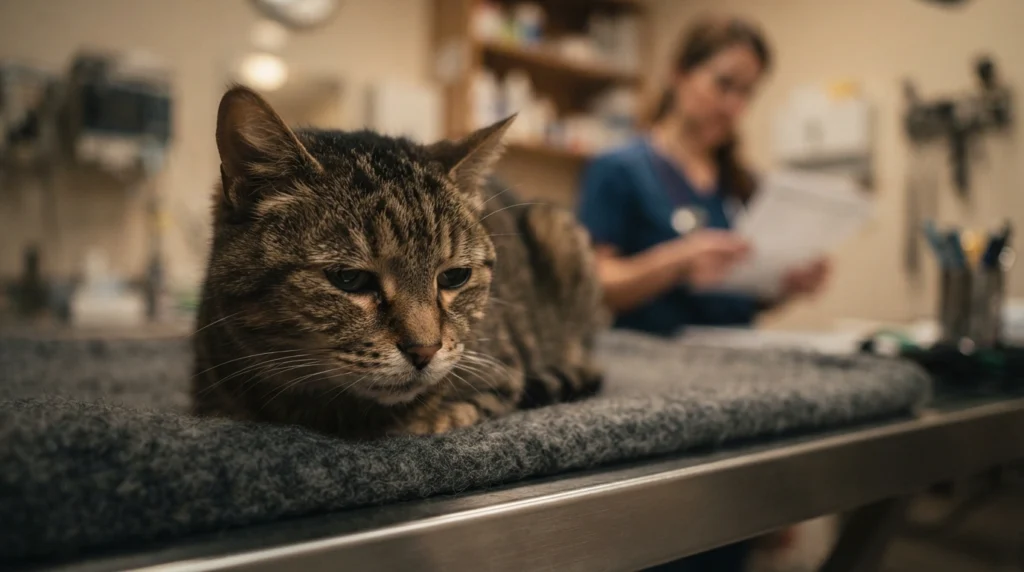
Not every litter-box change is an emergency, but a persistent change deserves attention.
Watch for:
- Urinating outside the box.
- Defecating outside the box.
- Increased litter-box visits.
- Straining.
- Blood in urine.
- Crying during elimination.
- Excessive genital licking.
- Constipation.
- Diarrhea.
- Very small urine clumps.
- A sudden increase or decrease in urine production.
- Strong changes in stool appearance.
- Avoiding the litter box.
- Suddenly hiding or acting painful.
Cornell lists difficulty or painful urination, increased frequency, crying during urination, blood in the urine, inappropriate urination, and genital licking among common signs of feline lower urinary tract disease.
VCA similarly notes that cats with lower urinary tract disease may strain in the litter box, pass small quantities of urine, show blood in urine, urinate in unusual places, or repeatedly attempt to urinate.
Emergency Signs vs. Problems Requiring a Veterinary Appointment
| Sign | Possible concern | Recommended response |
|---|---|---|
| No urine despite repeated straining | Possible urinary obstruction | Emergency veterinary care |
| Repeated painful urination | Lower urinary tract problem | Prompt veterinary assessment |
| Blood in urine | Urinary tract disease or other problem | Contact veterinarian promptly |
| Occasional accident with normal behavior | Behavioral or environmental issue possible | Monitor and assess |
| Constipation or repeated straining to defecate | Digestive or other medical problem | Veterinary assessment |
| Diarrhea continuing or accompanied by illness | Gastrointestinal problem | Contact veterinarian |
| Refusal to use a new automatic box | Fear or box aversion possible | Restore familiar box and monitor |
| Dirty or overflowing box | Environmental problem | Clean and maintain the box |
The table is a guide, not a diagnosis. A veterinarian must determine the cause of an individual cat’s signs.
How a Self Cleaning Litter Box Works
Different systems use different mechanisms.
Rotating systems
A rotating chamber may move litter through a screening or separation process after a delay. Waste is deposited into a covered compartment while usable litter returns to the main area.
Raking systems
Some models use a mechanical rake that travels through the litter and pushes clumps into a waste compartment.
Sifting systems
Other designs separate waste from reusable litter through a screen or sieve.
Conveyor-style systems
Some automated boxes move waste along a conveyor into a receptacle.
The technology differs, but the objective is similar: remove waste without requiring the owner to scoop every time the cat uses the box.
Before purchasing one, read the manufacturer’s operating instructions carefully.
Benefits of a Self Cleaning Litter Box
Reduced daily scooping
The most obvious benefit is convenience.
Instead of removing every clump manually, the machine handles routine waste removal according to its programmed cycle.
Potentially cleaner litter
Frequent automated waste removal can help keep feces and urine clumps out of the main litter area.
That may make the toilet environment more appealing to cats that prefer a clean box.
Cornell recommends keeping litter boxes clean and notes that many cats dislike foul odors.
Easier routine management
Owners with demanding schedules may find automation helpful.
It can also be useful for households where maintaining multiple litter boxes is difficult.
Helpful for some multi-cat households
Multiple cats create more waste.
An automated system may reduce the amount of manual scooping, although it should not be assumed that one automated box is enough for several cats.
Cornell generally recommends providing the number of litter boxes equal to the number of cats plus one.
Limitations of Automatic Litter Boxes
Automation has clear advantages, but there are trade-offs.
It does not eliminate cleaning
Waste compartments still need to be emptied.
Surfaces may need washing.
Litter can stick to components.
Odors can develop.
Filters may need replacement.
The mechanism itself can collect debris.
It may hide useful health information
This is one of the biggest considerations for cat owners.
Normal litter-box waste can provide useful clues about a cat’s health.
Changes in urine volume, frequency, stool consistency, or elimination habits may be important.
If the machine removes everything quickly, you may see fewer details unless you deliberately monitor the cat and the waste compartment.
Some cats dislike automation
Cats may reject a box because of:
- Noise
- Vibration
- Movement
- Odor
- Location
- Litter texture
- Small entrance
- Covered design
- Sudden movement after they leave
A frightened cat may begin avoiding the box.
Mechanical failures happen
Any machine can malfunction.
A jammed mechanism could interfere with waste removal.
A sensor problem could prevent a cleaning cycle.
A power interruption could stop an electrical model.
That is why manual inspection remains important.
Choosing the Right Self Cleaning Litter Box
Consider your cat’s size
A large cat needs enough space to enter, turn, squat, and exit comfortably.
Do not choose a model solely because it fits the available room.
Think about age and mobility
Older cats may have arthritis or reduced mobility.
A high entrance can become difficult to use.
Cornell notes that elderly cats and cats with mobility problems may need litter boxes with low sides.
Consider litter preference
Cats can be particular about litter texture and scent.
A machine that requires a specific litter may not work well if your cat strongly prefers another type.
Evaluate noise
If possible, choose a quieter design for a nervous cat.
The goal is not simply to automate scooping.
The goal is to create a toilet environment your cat willingly uses.
Check maintenance requirements
Before buying, find out:
- How often the waste bin must be emptied.
- Which litter types are allowed.
- How often filters need replacement.
- How the machine is cleaned.
- Whether the motor or pump needs maintenance.
- What happens during a power outage.
- What safety features are included.
- Whether replacement parts are available.
How to Introduce a Self Cleaning Litter Box
Do not immediately throw away your old litter box.
A gradual transition is usually more sensible.
Step 1: Put the new box nearby
Place the automated unit in an accessible location.
Keep the familiar box available.
Step 2: Use familiar litter
If the manufacturer permits it, use a litter your cat already accepts.
Suddenly changing both the box and litter can make the transition harder.
Step 3: Let your cat investigate
Allow your cat to approach the device naturally.
Do not place the cat inside and force it to remain there.
Step 4: Delay automation if possible
If the machine allows a manual or delayed mode, consider allowing your cat to become comfortable with the box before activating the cleaning mechanism.
Step 5: Watch for avoidance
If your cat stops using the new box, go back to the familiar option.
The cat’s willingness to eliminate normally is more important than automation.
Where Should You Put the Box?
Location can make a major difference.
Cats generally benefit from a quiet, accessible toilet area.
Cornell recommends locations that are private, quiet, and easy to access, while advising owners to avoid placing litter boxes near feeding areas.
Avoid locations where:
- Loud appliances operate.
- Children frequently disturb the cat.
- Another animal can block access.
- The cat must climb stairs unnecessarily.
- The box is difficult to reach.
- The cat can feel trapped.
In multi-cat homes, spreading boxes throughout the home can help prevent one cat from controlling access to all toilet areas.
Cleaning and Maintenance
Even the best automatic system requires human maintenance.
A practical routine includes:
- Check the waste compartment regularly.
- Remove waste before the compartment becomes full.
- Inspect the litter level.
- Check for stuck clumps.
- Clean surfaces according to manufacturer instructions.
- Wash removable components appropriately.
- Clean sensors carefully if instructed.
- Replace filters when required.
- Inspect electrical components and cords.
- Confirm the mechanism is operating normally.
Never ignore unusual grinding, repeated jams, overheating, or other signs of malfunction.
If the unit behaves unpredictably, stop using it until you can determine whether it is safe.
Can a Self Cleaning Litter Box Cause Cats to Avoid the Box?
It can contribute to avoidance if the cat finds the machine frightening or unpleasant.
However, litter-box avoidance can also have medical causes.
Cornell explains that urinary inflammation can make urination painful, causing a cat to associate the litter box with pain and subsequently avoid it. Digestive disease, kidney disease, diabetes, mobility problems, and other conditions can also contribute to house-soiling.
Therefore, do not automatically label a cat’s avoidance as a behavioral problem.
If the change is sudden, a veterinary examination may be appropriate.
Litter Boxes and Urinary Health
A clean and accessible litter box may encourage normal elimination, but it does not prevent every urinary disorder.
Feline lower urinary tract disease includes multiple conditions, including idiopathic cystitis, urinary stones, and urethral obstruction.
A cat may show:
- Frequent urination
- Painful urination
- Blood in urine
- Urinating outside the box
- Excessive genital licking
- Straining
An automated box can make waste management easier, but it cannot diagnose any of these conditions.
If your cat shows urinary symptoms, veterinary assessment is more important than changing the litter-box model.
Litter Boxes and Constipation
Constipation can also affect litter-box behavior.
Merck Veterinary Manual explains that constipation involves infrequent or difficult passage of feces and that factors can include inadequate water intake, reluctance to defecate, painful defecation, obstruction, and other medical problems.
A cat that repeatedly strains in the litter box may be trying to urinate rather than defecate.
That distinction can be difficult for owners to make.
If you are unsure what your cat is attempting to pass, do not assume constipation is the problem.
A veterinarian should evaluate persistent straining.
What Happens at the Veterinary Visit?
When litter-box behavior changes, the veterinarian will typically start with a history and physical examination.
You may be asked:
- When did the problem begin?
- How often does the cat use the box?
- Is urine being produced?
- Is the cat passing stool?
- Has appetite changed?
- Is water intake different?
- Has vomiting occurred?
- Has the household routine changed?
- How many litter boxes are available?
- What litter is being used?
- Has a new box recently been introduced?
Depending on the signs, diagnostic testing may include urinalysis, blood work, urine culture, radiographs, ultrasound, or other tests.
Cornell notes that cats with lower urinary tract signs commonly undergo a physical examination and urinalysis, with additional testing such as blood work, X-rays, ultrasound, or urine culture when appropriate.
The diagnostic approach depends on the individual cat.
Treatment Depends on the Cause
There is no single treatment for litter-box problems.
A veterinarian may recommend treatment for an underlying urinary disorder, digestive disease, pain condition, infection, or another medical issue.
For urinary obstruction, treatment can involve relieving the obstruction, stabilizing fluid and electrolyte abnormalities, and providing supportive care. Cornell describes catheterization and veterinary fluid therapy among treatments used for obstructed cats.
For behavioral or environmental problems, management may focus on litter type, box number, box location, environmental enrichment, stress reduction, and household changes.
The important point is that treatment should follow the cause rather than simply treating the litter-box behavior itself.
Prevention and Monitoring
A good litter-box routine can help you identify problems early.
Provide enough boxes
A commonly recommended starting point is one box per cat plus one additional box.
Keep boxes accessible
Cats should not have to navigate difficult stairs or blocked passageways.
Keep litter clean
Even with automation, inspect the box regularly.
Watch elimination patterns
Know what is normal for your cat.
Monitor older cats closely
Mobility and age-related diseases can affect litter-box use.
Minimize sudden environmental changes
Stress can contribute to some urinary disorders and behavioral changes. Cornell identifies environmental modification and stress reduction as useful components in managing feline idiopathic cystitis.
Keep fresh water available
Adequate water access is important for feline urinary health. Cornell recommends clean, fresh water and clean litter boxes as part of measures to minimize lower urinary tract disease risk.
Is a Self Cleaning Litter Box Worth It?
For the right household, it can be.
It may be especially appealing if you:
- Have a busy schedule.
- Prefer automated cleaning.
- Want to reduce daily scooping.
- Have difficulty handling litter manually.
- Are willing to perform regular maintenance.
- Have a cat that accepts automated equipment.
But it may not be the best choice if your cat:
- Is frightened by mechanical noise.
- Rejects enclosed or unusual boxes.
- Has mobility limitations that make access difficult.
- Requires close monitoring of urine or stool output.
- Has repeatedly developed litter-box aversion.
In a medically fragile cat, discuss the setup with your veterinarian before making a major change.
FAQs About Self Cleaning Litter Boxes
Is a self cleaning litter box safe for cats?
A properly designed and maintained automatic box can be safe for many cats. Safety depends on the model, correct installation, appropriate sizing, and regular maintenance. Cats that become frightened or stop using the box may need a different setup.
Do self cleaning litter boxes really stay clean?
They can reduce the amount of waste left in the main litter area, but they do not stay clean without maintenance. Owners still need to empty waste compartments, clean components, maintain litter levels, and follow the manufacturer’s instructions.
Can a self cleaning litter box replace a normal litter box?
Not necessarily. Some cats prefer traditional boxes, and maintaining an additional conventional box can be useful during transitions or for cats that dislike automated systems.
How many litter boxes should I have for my cats?
A commonly recommended starting point is one litter box per cat plus one additional box. Individual households may need more depending on space, cat relationships, mobility, and medical needs.
Can an automatic litter box help with litter-box avoidance?
It may help if the problem is related to waste accumulation, but it can also make avoidance worse if the cat dislikes the machine. Sudden litter-box avoidance should not automatically be treated as a behavioral issue because medical problems can cause it.
Why is my cat repeatedly going to the litter box but producing little urine?
Repeated attempts with little or no urine can indicate lower urinary tract disease or urinary obstruction. If a cat cannot urinate normally, especially if it is straining or distressed, seek immediate veterinary care. Urethral obstruction is a medical emergency.
Can an automatic litter box cause urinary problems?
An automatic box is not automatically a cause of urinary disease. However, if a cat avoids it because of noise, movement, location, litter preference, or fear, reduced willingness to use the box may become a problem. Medical causes of urinary signs must also be considered.
Should I use a self cleaning litter box for an older cat?
It depends on the cat’s mobility, preferences, and health. Older cats with arthritis or mobility limitations may need a low-entry, easily accessible box.
How often should I clean an automatic litter box?
Follow the manufacturer’s instructions, but do not wait for obvious buildup or odor. Inspect the waste area, litter, sensors, moving components, and surfaces regularly.
Internal-Link Opportunities
For a cat-health website, useful internal links could include:
- “cat urinary blockage symptoms” → detailed emergency urinary obstruction guide.
- “signs of constipation in cats” → feline constipation article.
- “cat litter box problems” → broader house-soiling and behavioral guide.
- “how to choose the right litter box” → litter-box selection guide.
- “feline lower urinary tract disease” → comprehensive urinary-health article.