A Complete Guide to Better Cat Hydration
Quick Answer
A cat water fountain can encourage some cats to drink more, but it is not a substitute for veterinary care, fresh water, or treatment of an underlying illness. Cats have individual preferences, and some prefer moving water while others prefer a traditional bowl.
If your cat suddenly stops drinking, becomes weak or lethargic, has repeated vomiting or diarrhea, has dry or tacky gums, or shows other signs of illness, contact a veterinarian promptly. Severe dehydration can become dangerous and may require veterinary fluid therapy. Cornell Feline Health Center notes that water is essential for normal circulation, temperature regulation, digestion, electrolyte balance, and organ function.
For a healthy cat, the goal is simple: provide clean water in an accessible location and make drinking easy and appealing. A fountain can be one useful option, especially if your cat enjoys running water.
Editorial note: This article is informational and has been reviewed against current guidance from recognized veterinary authorities. It does not diagnose or treat individual animals. A veterinarian should evaluate any cat with concerning changes in drinking, urination, appetite, behavior, or overall health.
Why Water Matters So Much for Cats
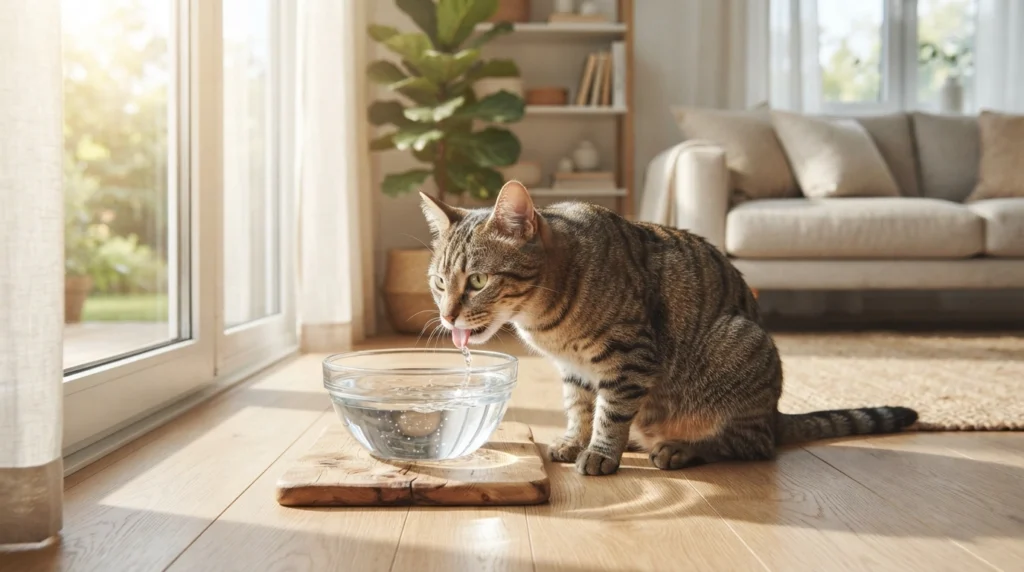
Water is one of the most important nutrients a cat needs. It supports circulation, digestion, temperature control, normal electrolyte concentrations, and many other body functions.
Cats can obtain water both by drinking and through food. This is especially important because wet or canned food contains substantially more moisture than dry kibble. Therefore, a cat eating mostly wet food may naturally drink less from a bowl than a cat eating primarily dry food.
A useful general estimate from Cornell and VCA is about 4 ounces of water per 5 pounds of lean body weight per day, although this is not a rigid target for every cat. Diet, temperature, activity, age, and health conditions can all affect fluid requirements.
For example, a 10-pound cat may have a general daily water requirement around 8 ounces, but that does not mean the cat must drink 8 ounces directly from a bowl. Moisture in food contributes to total intake.
This distinction matters when evaluating whether your cat is drinking “enough.”
How a Cat Water Fountain Works
A fountain continuously circulates water through a small pump and reservoir. Depending on the design, water may flow as a stream, bubble upward, or spill gently over a surface.
The appeal is partly behavioral. Some cats seem attracted to moving water, while others may ignore it completely. Cornell specifically notes that some cats increase their water intake when offered fountains, but individual preferences vary.
VCA similarly recommends trying a fountain for cats that enjoy running water. It also emphasizes regular cleaning and filter replacement according to the manufacturer’s instructions.
A fountain therefore should be viewed as an option for encouraging hydration, not as a medical device.
Benefits of Using a Cat Water Fountain
1. Moving water may encourage drinking
Some cats are naturally interested in dripping taps, streams, and moving water. A fountain can provide a controlled version of this behavior without leaving a tap running.
For a cat that repeatedly seeks water from the sink, a fountain may be worth trying.
2. It can provide another water source
Multiple water sources can make hydration easier, especially in homes with several cats.
Merck Veterinary Manual recommends keeping clean, fresh water available and notes that multiple water sources can encourage consumption.
3. It may be useful for cats that need encouragement to drink
Increasing water intake can be particularly relevant when a veterinarian has advised greater hydration for a specific medical reason.
For example, veterinary management of some urinary conditions may include strategies designed to increase water intake. However, cats with diagnosed kidney disease, urinary disease, diabetes, or another medical condition should receive individualized advice from their veterinarian rather than relying on a fountain alone.
4. It can make water more interesting
Some cats are simply selective about their drinking environment. A fountain changes the sensory experience by adding movement and sound.
That may be enough to make drinking more appealing to a cat that otherwise ignores a still bowl.
5. It can complement wet food
A fountain does not have to replace other hydration strategies.
Wet or canned food can contribute significant moisture to a cat’s overall water intake. VCA and Cornell both identify moisture-rich food as another way to support hydration.
Do All Cats Need a Fountain?
No.
There is no veterinary requirement that every cat drink from a fountain.
A healthy cat may be perfectly comfortable drinking from a clean bowl. In fact, forcing a cat to use a fountain can be counterproductive if the cat becomes frightened by the pump, noise, movement, or unfamiliar object.
The priority is access to clean, safe water.
Some cats prefer ceramic or stainless-steel bowls. Others prefer wide dishes, shallow containers, or running water. VCA recommends experimenting with bowl materials, sizes, water temperature, locations, and fountains to identify individual preferences.
Choosing the Best Cat Water Fountain
There is no single fountain that is ideal for every household. Instead, consider practical factors.
Material
Look for a fountain made from a durable, easy-to-clean material.
Stainless steel and ceramic are common choices. Plastic can also be used, but the most important factor is whether the fountain can be cleaned thoroughly and maintained properly.
Size and capacity
Choose a capacity that suits the number of cats using it.
A single-cat household may need less capacity than a home with several cats. However, a larger reservoir should never be an excuse to leave water unchanged for extended periods.
Ease of cleaning
This may be more important than appearance.
A fountain with many small parts, narrow tubes, or difficult-to-reach areas can become frustrating to clean. Before buying, check whether the pump, reservoir, spout, and other components can be removed and washed according to the manufacturer’s instructions.
Filter availability
Many fountains use replaceable filters.
Before purchasing, check whether replacement filters are readily available and whether the manufacturer specifies how often they should be replaced.
A filter does not eliminate the need for cleaning.
Pump noise
Some cats tolerate quiet pumps better than noisy ones.
If your cat is cautious or easily startled, a loud fountain may discourage use.
Electrical safety
If you choose an electric model, keep cords away from areas where your cat can chew them or where water can create a hazard.
For kittens and curious cats, cord management deserves particular attention.
How to Introduce a Fountain to a Cat
Do not assume your cat will immediately accept it.
A gradual introduction is often easier.
- Keep the normal water bowl available. Do not remove your cat’s familiar water source immediately.
- Place the fountain nearby but not directly beside the bowl.
- Allow your cat to investigate it while it is switched off, if appropriate for the model.
- Turn it on and observe your cat’s reaction.
- Keep the environment calm.
- Continue offering the preferred water source.
- Watch whether drinking behavior changes.
If your cat refuses the fountain, that is not necessarily a problem. A clean traditional bowl is still a valid water source.
VCA recommends offering different water bowls and locations because cats can have strong individual preferences.
How Often Should a Cat Water Fountain Be Cleaned?
Cleaning frequency depends on the fountain design, number of cats, water quality, and manufacturer instructions.
As a practical rule, do not wait until the fountain looks dirty.
VCA recommends washing water bowls daily and cleaning fountain filters weekly or as directed by the manufacturer.
A basic maintenance routine can include:
- Emptying old water before refilling.
- Washing removable parts regularly.
- Removing visible hair and debris.
- Cleaning the pump according to manufacturer instructions.
- Replacing filters on schedule.
- Rinsing components thoroughly.
- Checking for slime, residue, odor, or buildup.
- Refilling with fresh water.
If several cats share one fountain, more frequent cleaning may be appropriate.
Signs Your Cat May Not Be Getting Enough Water
Do not judge hydration only by how often you see your cat drink.
Cats may consume substantial moisture through food, and owners may not observe every drinking episode.
Possible signs of dehydration can include:
- Lethargy
- Weakness
- Poor appetite
- Dry or tacky gums
- Reduced skin elasticity
- Sunken-looking eyes in more severe cases
Cornell identifies these among possible signs of dehydration and recommends contacting a veterinarian when dehydration is a concern.
A sudden change in drinking behavior can also be medically important.
For example, drinking substantially more water and urinating more frequently can occur with certain diseases, including chronic kidney disease and diabetes. Merck also emphasizes that changes in water intake can be associated with illness.
When Reduced Drinking Is an Emergency
A cat that drinks slightly less on one day but is otherwise bright, eating normally, urinating normally, and behaving normally may not necessarily have an emergency.
However, urgent veterinary attention is appropriate when reduced drinking occurs alongside significant illness.
Seek urgent veterinary care if your cat has:
- Severe weakness or collapse
- Repeated vomiting or diarrhea
- Severe lethargy
- Difficulty breathing
- Signs of significant pain
- Inability to keep water down
- Very poor appetite combined with illness
- Suspected toxin exposure
- A major injury
- Severe dehydration
- Difficulty urinating or repeated unsuccessful attempts to urinate
A cat that cannot urinate may have a potentially life-threatening urinary obstruction and should be treated as an emergency.
A fountain should never be used as a substitute for emergency veterinary evaluation.
When a Routine Veterinary Appointment Is Appropriate
Some situations are better handled through a prompt scheduled appointment.
Arrange veterinary assessment if you notice:
- A persistent increase in drinking
- A persistent decrease in drinking
- Increased urination
- Weight loss
- Changes in appetite
- Recurrent urinary problems
- Repeated vomiting
- Ongoing diarrhea
- Changes in energy or behavior
Increased thirst can sometimes accompany conditions such as kidney disease or diabetes, while dehydration can occur when water losses increase or intake falls. Cornell specifically lists chronic kidney disease, diabetes, vomiting, diarrhea, and hyperthyroidism among conditions associated with dehydration or increased water loss.
Water Fountains and Urinary Health
Hydration is an important part of overall urinary health, but it is only one part.
Veterinarians may encourage increased water intake for cats with certain urinary conditions because more water can help produce more dilute urine and support more frequent urination.
For example, VCA notes that increasing water intake can be part of management strategies for crystalluria and certain urinary stones.
However, the appropriate diet and treatment depend on the actual diagnosis.
Do not assume that a fountain can prevent or cure urinary disease.
If your cat strains to urinate, cries in the litter box, repeatedly enters the litter box without producing urine, or produces little or no urine, contact a veterinarian immediately.
Water Fountains for Cats With Kidney Disease
Cats with chronic kidney disease may have increased hydration needs because the disease can interfere with the kidneys’ ability to concentrate urine.
Some cats with chronic kidney disease prefer fountains, and Cornell notes that clean bowls and multiple water locations can also encourage drinking. In more advanced cases, veterinary fluid therapy may be necessary.
If your cat has kidney disease, ask your veterinarian about:
- Daily hydration goals
- Suitable food
- Whether additional fluids are needed
- Monitoring body weight
- Signs of worsening dehydration
- Appropriate follow-up testing
Do not administer fluids at home unless your veterinarian has specifically prescribed them and shown you how to do so safely.
Can a Fountain Replace a Water Bowl?
Ideally, do not rely on a single source.
Providing more than one accessible water source can be helpful, particularly in multi-cat households.
Some cats may prefer a bowl while another prefers moving water. Having both options allows the cat to choose.
Water stations should be positioned in quiet areas where the cat feels comfortable. VCA also recommends keeping water bowls away from litter boxes.
Common Mistakes to Avoid
Leaving the fountain uncleaned
A large reservoir does not mean the water remains clean indefinitely.
Assuming the filter does all the cleaning
Filters are designed for a specific function. They do not remove the need to wash the fountain.
Removing all other water sources
If your cat dislikes the fountain, removing the familiar bowl could reduce water access.
Forcing a frightened cat to use it
Allow the cat to decide whether the fountain is appealing.
Ignoring changes in thirst
A fountain can make it easier to provide water, but it does not explain why your cat suddenly drinks much more or much less.
Using unsafe additives
Do not add supplements, medications, essential oils, or other substances to your cat’s water unless your veterinarian specifically recommends them.
How to Monitor Your Cat’s Hydration
You do not need to obsessively measure every sip.
Instead, monitor the bigger picture.
Pay attention to:
- Drinking habits
- Appetite
- Urination
- Stool quality
- Body weight
- Energy
- Grooming
- Behavior
- Vomiting or diarrhea
If your cat uses a fountain, you may also notice how quickly the reservoir level falls. However, evaporation, splashing, and multiple pets can make reservoir measurements imperfect.
For cats with medical conditions, your veterinarian may recommend more specific monitoring.
What Veterinary Assessment May Involve
If your veterinarian is concerned about hydration or abnormal drinking, the evaluation will depend on the symptoms.
A typical workup may include:
- History: The veterinarian may ask about food, water intake, urination, vomiting, diarrhea, medications, activity, and recent behavior.
- Physical examination: Hydration status, gums, weight, heart rate, breathing, and other physical findings may be assessed.
- Blood testing: Depending on the situation, blood tests may help evaluate kidney function, glucose, electrolytes, and other health indicators.
- Urinalysis: Urine testing can provide important information about concentration and urinary health.
- Imaging: Ultrasound or radiographs may be considered when the clinical picture warrants them.
- Additional tests: Further testing may be recommended based on initial findings.
The purpose is not simply to determine whether the cat needs more water. It is to identify whether an underlying condition is affecting hydration.
Treatment Depends on the Cause
There is no universal treatment for dehydration or abnormal drinking.
Veterinary treatment may include addressing the underlying illness, improving access to water, changing diet, controlling vomiting or diarrhea, or administering fluids.
For significantly dehydrated cats, veterinarians may use intravenous or subcutaneous fluids depending on the patient’s condition. Cornell notes that veterinary fluid therapy may be needed when dehydration is significant or associated with disease.
Merck Veterinary Manual also describes fluid therapy as a structured process involving assessment of dehydration, maintenance requirements, and ongoing losses.
The exact treatment should therefore be determined by a veterinarian.
Cat Water Fountain vs. Traditional Bowl
| Feature | Fountain | Traditional Bowl |
|---|---|---|
| Moving water | Yes | No |
| Useful for cats attracted to running water | Often | Sometimes |
| Requires electricity | Many models do | No |
| Requires filter maintenance | Some models | No |
| Cleaning required | Yes | Yes |
| Suitable as a water source | Yes | Yes |
| Best for every cat | No | No |
| Can replace veterinary treatment | No | No |
The important takeaway is that the “best” water setup is the one your cat will reliably use while remaining clean, safe, and accessible.
FAQs About Cat Water Fountains
Is a cat water fountain better than a bowl?
Not automatically. Some cats prefer moving water, while others prefer a traditional bowl. The best option is the one that provides clean, accessible water and fits your cat’s preference.
How often should I clean my cat’s fountain?
Follow the manufacturer’s cleaning instructions and clean it regularly. VCA recommends cleaning filters weekly or as directed and emphasizes regular washing of water containers.
Can a fountain help my cat drink more water?
It can. Some cats are attracted to moving water, and veterinary sources recommend trying fountains as one way to encourage drinking. However, not every cat responds to them.
Should my cat have a water bowl as well as a fountain?
It is reasonable to provide multiple water sources. This is particularly useful if your cat has strong preferences or if multiple cats share the home.
Can a water fountain prevent kidney disease?
No. A fountain may support hydration, but it cannot guarantee prevention of kidney disease. Cats with kidney disease require veterinary evaluation and individualized management.
Why is my cat suddenly drinking much more water?
A persistent increase in drinking can have several causes, including medical conditions. If the change is significant or accompanied by increased urination, weight loss, appetite changes, or other symptoms, schedule a veterinary examination.
What if my cat refuses the fountain?
Do not force the issue. Keep providing fresh water in a familiar bowl and try introducing the fountain gradually. Your cat does not have to use a fountain to remain hydrated.
Can kittens use a water fountain?
Kittens can use appropriate water fountains, but the fountain should be stable, safe, and easy to access. Very young kittens have different nutritional and hydration needs, so concerns about dehydration or poor drinking should be discussed with a veterinarian. VCA recommends appropriate hydration opportunities and veterinary attention when a young cat remains dehydrated.
Should I worry if my cat drinks very little?
Not necessarily, particularly if your cat eats moisture-rich wet food. But a sudden or persistent change in drinking behavior should not be ignored, especially if other signs of illness are present.
Internal-Link Opportunities
For an informational cat-health website, consider linking this article to related pages using descriptive anchor text such as:
- “signs of dehydration in cats” → dehydration symptoms guide
- “why is my cat drinking so much water?” → excessive thirst/polydipsia article
- “cat urinary problems and warning signs” → feline urinary health guide
- “cat kidney disease symptoms” → chronic kidney disease article
- “how to encourage a cat to drink more water” → feline hydration guide
These links create useful topical relationships without forcing the focus keyword into every anchor.
Recommended External References
For medical and veterinary claims, prioritize recognized veterinary authorities rather than commercial fountain sellers or anonymous pet blogs.
- Cornell University College of Veterinary Medicine, Cornell Feline Health Center: feline hydration guidance and chronic kidney disease information.
- VCA Animal Hospitals: practical guidance on encouraging cats to drink, fountains, bowls, urinary conditions, and nutrition.
- Merck Veterinary Manual: veterinary information concerning water requirements, nutrition, dehydration, and fluid therapy.
These are preferable to citing unsupported statistics, product reviews, or unverified social-media claims.
Conclusion
A cat water fountain can be a useful tool for encouraging hydration, especially for cats that enjoy moving or running water. But it is not essential for every cat, and it should never be treated as a cure for dehydration or an underlying medical condition.
The most important principles are straightforward: provide clean water at all times, consider multiple water sources, keep bowls and fountains hygienic, offer moisture-rich food when appropriate, and monitor changes in drinking or urination.
If your cat suddenly stops drinking, appears dehydrated, becomes weak, vomits repeatedly, develops severe diarrhea, struggles to urinate, or shows another concerning symptom, seek veterinary advice rather than trying to solve the problem with a new fountain.
Good hydration starts with access and preference. Good veterinary care starts with recognizing when a change in drinking behavior may be a sign of something more serious.
References
- Cornell University College of Veterinary Medicine, Cornell Feline Health Center. “Hydration.” Veterinary guidance on feline hydration, water requirements, dehydration signs, and ways to encourage drinking.
- Cornell University College of Veterinary Medicine, Cornell Feline Health Center. “Chronic Kidney Disease.” Guidance concerning hydration and water access in cats with chronic kidney disease.
- VCA Animal Hospitals. “How To Get Your Cat To Drink More Water.” Practical veterinary guidance on fountains, bowls, wet food, and hydration.
- VCA Animal Hospitals. “How To Keep Your Kitten Hydrated.” Guidance on hydration and the use of water fountains for young cats.
- Merck Veterinary Manual. “Nutritional Requirements of Small Animals.” Veterinary reference covering water as an essential nutrient and factors affecting water requirements.
- Merck Veterinary Manual. “Maintenance Fluid Plan in Animals.” Veterinary reference concerning fluid requirements and fluid therapy.